
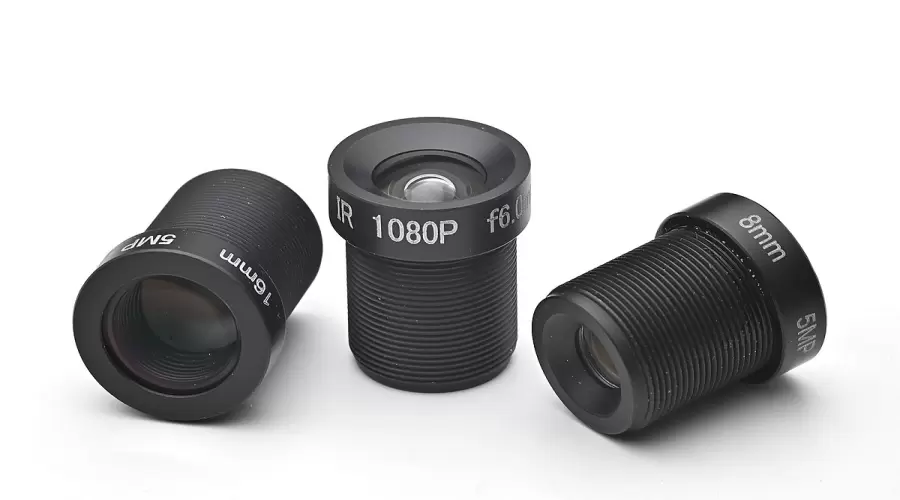
In the world of high-precision manufacturing and quality control, even a tiny error can lead to a big problem. When you are measuring small parts like microchips, automotive gears, or medical devices, you cannot afford "visual tricks." Standard camera lenses often make objects look bigger or smaller depending on how far they are from the glass. This is fine for a family photo, but it is a disaster for industrial metrology.
If you want to achieve perfect accuracy, you need to buy a C Mount Telecentric Lens. These specialized optical tools are designed specifically to remove the "perspective" that our eyes and normal lenses naturally have. In this guide, we will explore why these lenses are the secret weapon for distortion-free measurements and how they can transform your machine vision system.
To understand why a C Mount Telecentric Lens is different, think about looking down a long hallway. The far end of the hallway looks much smaller than the doorway you are standing in. This is called "perspective error" or "parallax."
A telecentric lens is engineered to ignore this rule. It only accepts light rays that are parallel to the optical axis. This means that no matter if an object is slightly closer to the lens or slightly farther away, its size on the camera sensor remains exactly the same.
The "C Mount" part refers to the standardized threading used to attach the lens to a camera. Most industrial cameras use this mount, making these lenses very easy to swap into your existing setup.
When you switch from a standard lens to a C Mount Telecentric Lens, you immediately notice several key advantages that make your inspection process more reliable.
In a normal lens, if a part on a conveyor belt wobbles or is placed at a slightly different height, the measurement will change. A telecentric lens ensures that the magnification is constant. This is crucial when you are measuring the diameter of a hole or the distance between two pins on a circuit board.
Standard lenses often have "barrel" or "pincushion" distortion, where straight lines look slightly curved at the edges of the image. High-quality telecentric lenses reduce this distortion to nearly zero (often less than 0.1%). This allows the software to calculate dimensions across the entire field of view without needing complex mathematical corrections.
Telecentric lenses provide a symmetrical blur. Even if an object is slightly out of focus, its "center of mass" or "centroid" stays in the same place. This makes it much easier for automated software to find edges and take accurate readings, even if the parts are thick or have complex heights.
As we move deeper into the era of automated manufacturing, the demand for precision is higher than ever. Components are getting smaller, and tolerances are getting tighter.
Automotive Industry: Measuring the exact pitch of screw threads or the gap in a spark plug.
Electronics: Inspecting the alignment of surface-mount components on a PCB.
Medical Devices: Ensuring the tiny needles or valves used in surgery are exactly the right size to the micron.
Without a C Mount Telecentric Lens, your vision system might "see" a part as passing inspection when it is actually too small, simply because the part was sitting a millimeter higher on the tray.
If you are ready to buy a C Mount Telecentric Lens, don't just pick the first one you see. You need to match the lens to your specific needs. Here are the most important specs to check:
| Feature | Importance |
| Magnification | Determines how large the object appears on your sensor. Common values are 0.5x, 1x, or 2x. |
| Working Distance | The distance between the front of the lens and the object. Make sure it fits your machine's physical space. |
| Sensor Compatibility | Ensure the lens can "cover" the size of your camera sensor (e.g., 2/3", 1", or 1.1"). |
| Telecentricity | Measured in degrees. The lower the number, the more "parallel" the light rays are, and the better the measurement. |
Getting the most out of your C Mount Telecentric Lens requires a bit of care during setup.
Stable Mounting: Because these lenses can be larger and heavier than standard ones, use a sturdy bracket. Vibrations from a factory floor can ruin high-precision measurements.
Proper Lighting: Telecentric lenses work best with "collimated" lighting. This is light that also travels in parallel rays. When you combine a telecentric lens with a telecentric backlight, you get a perfectly sharp silhouette of your part, which is ideal for measuring edges.
Cleanliness: Since these lenses are used for high-precision work, even a tiny speck of dust on the glass can look like a defect on your part. Keep the lens capped when not in use.
There are a few misunderstandings that often stop people from upgrading. Let’s clear those up:
"They are too expensive": While they cost more than a $50 security camera lens, the money you save by reducing "false rejects" and avoiding product recalls usually pays for the lens in a few months.
"They are too big": It is true that the front of a telecentric lens must be at least as large as the object you are measuring. However, for most small industrial parts, the size is very manageable.
"I can just fix distortion in software": You can fix shape distortion in software, but you cannot fix perspective error. If the magnification changes because the part moved, no amount of software can tell you the true size of that part without a telecentric lens.
If your job is to simply "see" if a part is present on a line, a regular lens is fine. But if your job is to measure, you cannot settle for anything less than a C Mount Telecentric Lens. It removes the guesswork, eliminates the errors caused by part movement, and provides the "true" image of the object.
Investing in high-quality optics is the easiest way to improve your machine vision system's performance. By choosing a lens designed for distortion-free measurement, you ensure that your quality control is a help, not a bottleneck, to your production.
Aliqu justo et labore at eirmod justo sea erat diam dolor diam vero kasd
Welcome to Articles Webhunk, your go-to source for trending news, insightful articles, and expert opinions across various topics. Stay updated with the latest in business, technology, lifestyle, and more!
Learn More About Us© Copyright 2024 - Articles Webhunk. All Rights Reserved.
