
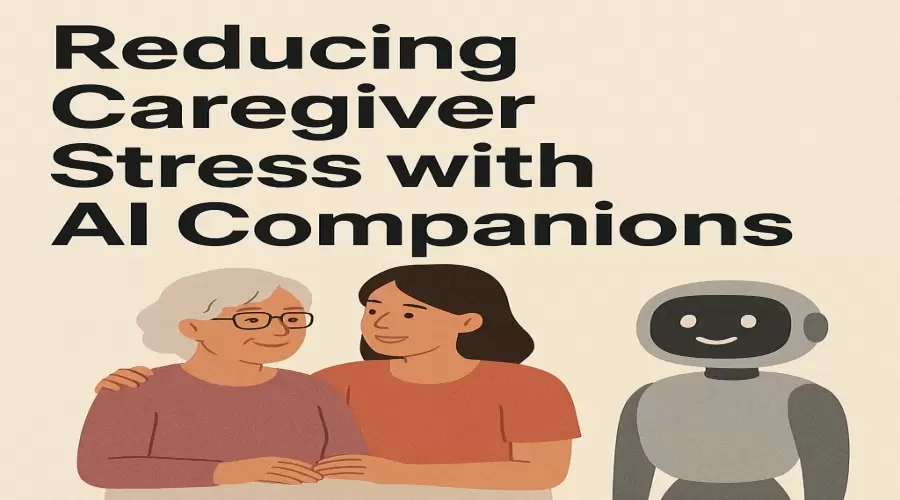
We all know caregiving is hard. What matters more is what’s changing now, and what might reshape how you and your aging parents live together (or apart) in the coming years.
We’re seeing a move beyond “smart sensors” or “fall detectors” to systems that talk, remind, nudge, and even reflect. In one pilot involving older adults, features like appointment reminders, emergency assistance, and health-monitoring via an AI chatbot scored highest interest - 89 %, 79 %, and 75 % respectively. (PMC)
This is powerful because many older adults don’t want “gadgets” added to their lives; they want something that fits, interacts, and feels human enough to be useful. Designing such conversational companions is becoming a research priority. (BioMed Central)
Globally, the market for virtual companion care was valued at USD 2,750 million in 2024 and is projected to grow steeply (CAGR ~12.9 %) toward 2035. (WiseGuy Reports) In parallel, the AI companion robot space is expected to grow even faster - from ~USD 10.8 billion in 2024 to over USD 94 billion in 2034 (CAGR ~24.2 %) (Market.us). That shows investors believe deeply in this transition.
Many adult children (or others) perform caregiving without fully identifying as caregivers. They may support aging parents with medication, coordinating visits, checking in socially - but not adopt the label “caregiver” until burden intensifies. That “hidden care” piece delays adoption of support tools until crisis point. (BioMed Central)
AI companions trained to prompt reflection - “how’s your day? is this schedule manageable?” - can help people see the pattern earlier and adopt helpful tech sooner. That design insight is emerging from recent work. (BioMed Central)
We tend to assume tech is equally helpful. But research shows caregivers of people with cognitive impairment (e.g. dementia) often perceive assistive technologies as less useful. (Frontiers) Why? Because the matching of device to stage, and gradual onboarding, matters heavily. Introducing an overly complex AI assistant too early or too late can backfire.
Also, caregivers experiencing higher strain (stress, hours) report higher usefulness of tech - because their need pushes them to seek help. (Frontiers) But if the caregiver is older or less tech-savvy, uptake drops. (Frontiers)
So the best design and adoption strategy is modular, adaptive, and attuned to gradual progression, not one-size fits all.
An often underdiscussed risk: when a machine or AI substitutes too much human presence, we risk increased loneliness. One study (in a care home setting) found heavy robot use was associated with a 40 % drop in human interactions, which correlated with worsened loneliness metrics. (learn2care)
So the goal isn’t replacement but augmentation. Technology must preserve or even enhance human-to-human connection, not erode it.
People worry about data misuse, surveillance, and autonomy. But beyond that, few sites dig into how consent should evolve over decades — not just day one. For example:
Also, many systems rely on internet connectivity and in lower-resource settings, that’s a barrier. People forget to ask: what if the broadband fails? Or the power goes off?
Barriers to adoption among informal caregivers include cost, complexity, lack of training, and infrastructure challenges. (PMC)
Traditional assistive tech was about detecting events (falls, skipped meds). The next wave is predictive insight. AI companions might detect subtle trends: changes in sleep patterns, mood shifts, slower response times, changes in speech or vocabulary. These signals, aggregated, could flag evolving health issues before the crisis.
Because of that, caregivers and doctors may get a new kind of “early warning system.” That said, false positives and alert fatigue are real dangers if not tuned right.
One emerging model: not “AI replaces the human caregiver,” but “AI + human” forms a team. The human handles empathy, nuance, oversight. The AI handles repetitious checking, reminders, monitoring.
Studies of AI support for informal caregiving show this is already happening: systems that support scheduling, reflection, and suggest outside resources are valued especially when caregivers don’t feel alone. (ResearchGate)
That means tools must surface “suggestions, not commands.” The design that respects human judgment tends to gain more trust and uptake.
Many trends focus on providing devices like tablets, sensors, wearables to seniors. But what matters more is tech literacy, confidence, and attitude. In one large study, 82.5 % of caregivers reported using smartphones, 84 % used computers but only 43.5 % used them for caregiving tasks. (PMC)
Older caregivers or care recipients often resist new systems out of fear or frustration. Some studies classify older adults into “technology adapters,” “technologically wary,” or “technology resisters.” (PMC)
To overcome this, adoption strategies must assume low initial comfort, training, gradual ramping. And community or peer support matters hugely.
When a trend becomes big, you see money flow. The virtual companion care market is growing; companion-robot sector is ballooning. (WiseGuy Reports)
Meanwhile, projects are turned into real pilots. In New York, there’s a program that turns the TV into a caregiving hub - medication reminders, memory games, daily check-ins using an AI companion (“Joy”) that connects to caregivers. (New York Post)
Also, the ElliQ companion robot just added features so it can send health updates to caregivers with no cameras, just signal-based monitoring and behavioral alerts. (The Verge)
These are early but concrete signs that conversational and ambient caregiving tech is shifting from lab to living room.
If I were advising a family ready to test an AI companion, I’d look for something that is privacy-first, adaptable, and integrates with human caregivers. One such tool is the best AI companions from Careflick. It is positioned as a companion that supports well-being, monitoring, reminders, and conversation without trying to overpromise. Using it doesn’t mean you stop visiting or caring, it means you get more support and peace of mind.
You can check frequently asked questions about Careflick.
Caregiving tech is finally moving beyond gadgets into companion systems that listen, adapt, and assist. But the transition is fragile - human connection, privacy, legitimate usability, and pacing matter enormously. As adult children of aging parents or as seniors yourselves, the goal isn’t to chase every gadget. It’s to find the right companion tools that free your time, reduce stress, and improve safety - without replacing the human heart of care. Let me ask you: what feature would you most want in an AI companion you’d trust to support your loved one - reminders, health insight, conversation, or something else entirely?
Aliqu justo et labore at eirmod justo sea erat diam dolor diam vero kasd
Welcome to Articles Webhunk, your go-to source for trending news, insightful articles, and expert opinions across various topics. Stay updated with the latest in business, technology, lifestyle, and more!
Learn More About Us© Copyright 2024 - Articles Webhunk. All Rights Reserved.
